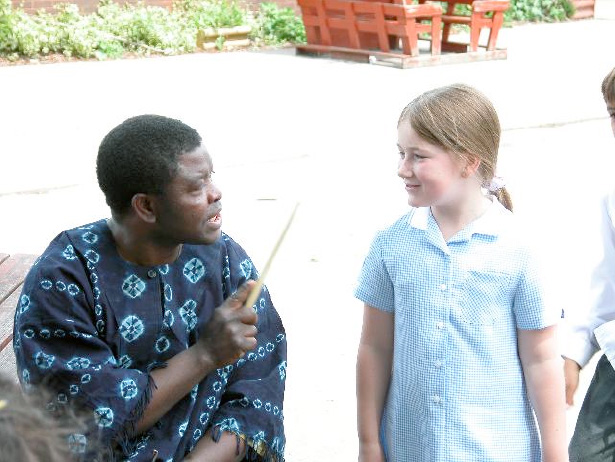
Kakatsitsi offer two main workshop formats:
- Drumming and Dance Workshops — Kakatsitsi’s standard workshop format, combining traditional Ghanaian drumming and dance. Participants are divided into two groups which swap activities during the session, so that everyone has the opportunity to experience both.
- Drumming, Singing and Percussion Workshops — a music-focused alternative in which participants learn separate drumming, vocal and percussion parts before coming together to perform the complete piece as an ensemble.
Both formats can be adapted according to the age of participants, group size and the time available, with workshops normally lasting 45–60 minutes. Schools can also work with Indigenous People to develop a bespoke workshop programme and timetable tailored to their particular needs, priorities and school day.
Drumming and Dance Workshops
Drumming and dance workshops are normally delivered to two classes at the same time, using two separate spaces. One class spends approximately 30 minutes learning a traditional Ghanaian rhythm on drums and percussion, while the other spends 30 minutes learning traditional Ghanaian dance.
After 30 minutes, the two classes swap activities, so that every child has the opportunity to experience both drumming and dance during the one-hour session.
The artists teach through demonstration, repetition and active participation, enabling children to become familiar with traditional rhythms and movements while developing listening, coordination, concentration and confidence.
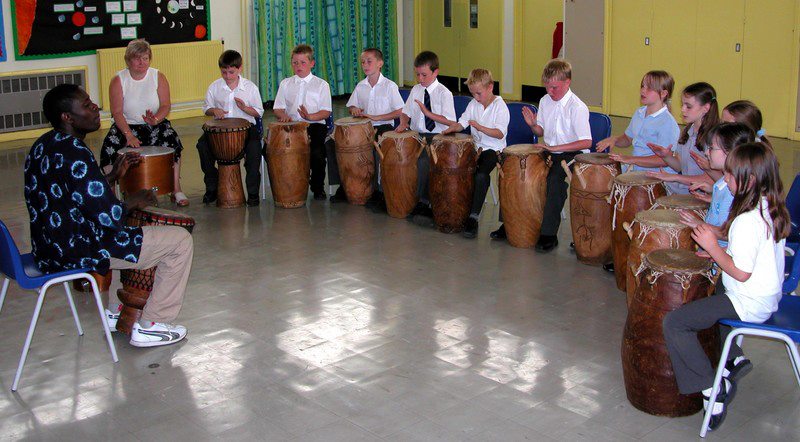
The workshop begins by showing the children how to hold and play the drum correctly. Where possible, each child sits with the drum held securely between the knees and tilted slightly away from the body. The teacher then demonstrates the two basic techniques used in the workshop — the bass and tone strokes — which the children practise repeatedly, first with one hand and then the other.
Once the basic techniques have been established, the rhythm is broken down into its component parts and taught progressively. As each part is mastered, it is combined with the previous one until the children are able to maintain the complete rhythm together.
The drum rhythm is then played alongside the bell pattern, allowing the children to hear how the different rhythmic patterns interlock and how the bell provides a reference point for the ensemble.
With older or more experienced students, a second or third drum rhythm can be introduced, crossing the first. The children learn to maintain their own individual rhythm while listening to the bell and to the other players, eventually bringing two or three interlocking rhythms together as a complete ensemble.
The Dance Workshop
The dance workshop introduces children to Kpanlogo, a traditional Ghanaian dance which they will normally have seen performed by Kakatsitsi during the morning’s educational performance.
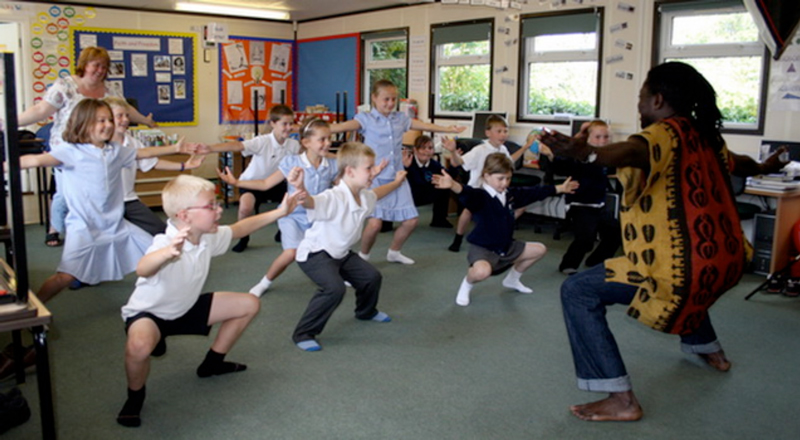
The artists teach the dance progressively, demonstrating a series of traditional movements which the children learn through observation, imitation and repetition. As their confidence develops, the individual movements are brought together into longer sequences and performed to live drumming.
An important part of the workshop is learning to listen and respond to the drum. Rather than treating the music simply as accompaniment, the children are encouraged to recognise the relationship between rhythm and movement, using what they hear from the drummers to guide the timing and character of the dance.
Drumming, Singing and Percussion Workshops
This workshop format is ideally designed for two classes, or approximately 60–65 children. Before the workshop begins, teachers are asked to divide the children into three roughly equal groups, ready to take part in drumming, singing and percussion. Having the groups organised in advance ensures that workshop time can be devoted to the activities themselves rather than to organising the children.
The workshop requires three separate spaces, with the drumming group normally based in the school hall. The three groups rotate between the activities during the session, giving every child the opportunity to experience each element. At the end, everyone comes together in the hall, where the separate drumming, singing and percussion parts are combined and performed as a complete ensemble.
Bringing It All Together
Once each group has experienced the drumming, percussion and singing workshops, all the children come back together in the hall to create a short collective performance.
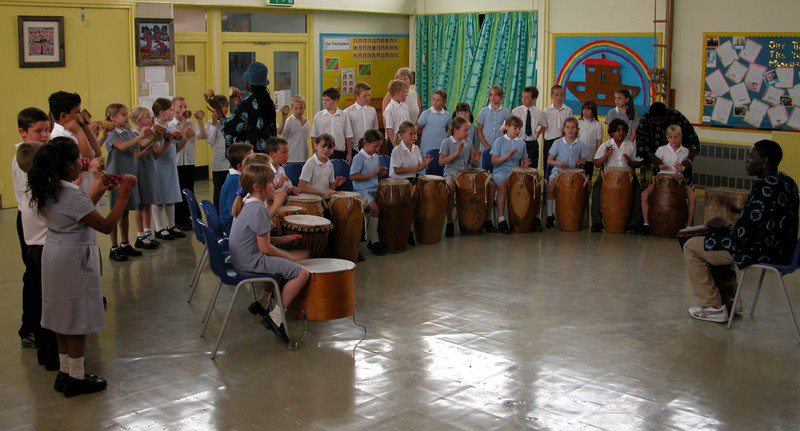
The piece is built up gradually, allowing the children to hear how the different elements fit together. The bell and shakers begin first, establishing the underlying rhythmic pattern. The drums then join in, adding their interlocking rhythms, before the singers are brought in over the complete percussion ensemble.
The singers use call and response, with a lead singer making the call and the rest of the group responding together, while the drums, bell and shakers maintain the rhythm.
Finally, the instruments fall silent and everyone sings together, bringing the workshop to a collective conclusion.
The final performance brings together everything the children have learned during the individual workshops and demonstrates how separate rhythms and voices can combine to create a single communal piece of music.
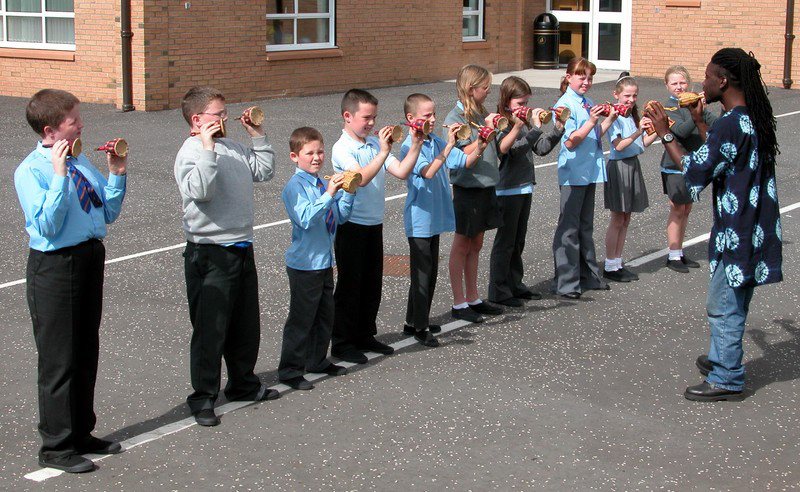
Bell and Shaker
The bell plays a central role in the traditional Ghanaian rhythms taught by Kakatsitsi, providing a repeated timing pattern which acts as a reference point for the whole ensemble. The children will already have encountered this pattern during the educational performance and in the drumming workshop.
In a traditional ensemble the pattern is played on the bell, but a group of 15–20 children playing bells together would be extremely loud. The children therefore learn the same pattern on shakers, while the teacher plays the bell. This allows them to experience the musical function of the bell pattern while keeping the volume of the workshop manageable.
The children are first shown how to hold the shaker and how to produce the pattern using alternating “out” and “in” movements. They are reminded of the timing pattern introduced during the performance and shown how to remember it by counting the rhythm aloud before transferring it onto the shaker.
Once the pattern has been established, the children practise maintaining it alongside the drum, learning how the repeated timing pattern provides a reference point for the drummer. Individual volunteers can then try playing with the drum, initially with support from the teacher and, as their confidence develops, maintaining the pattern independently.
Singing
The singing workshop develops the call-and-response patterns introduced during Kakatsitsi’s educational performance, together with other simple traditional chants. The children learn how the vocal phrases relate to the bell pattern and how the singing fits rhythmically with the other elements of the ensemble.
Children are encouraged to take turns leading the call, with the rest of the group responding together. Where time permits, each child is given the opportunity to lead, preparing the group for the final collective performance in which the singing is brought together with the drums, bell and shakers.