
Kakatsitsi’s educational performances and workshops have strong links with a number of areas within Scotland’s Curriculum for Excellence (CfE).
The most direct connections are with Expressive Arts, particularly Music and Dance, but the programme also supports learning within Health and Wellbeing, Religious and Moral Education, Social Studies and Literacy across Learning.
Through a combination of live performance, explanation and active participation, children encounter Ghanaian music, dance and culture directly while developing skills in listening, concentration, creativity, communication and working together.
As the great majority of Kakatsitsi’s educational work takes place in primary schools, this page focuses principally on learning at primary level. However, Kakatsitsi also work with secondary schools, colleges and universities, adapting performances, workshops and discussions to suit the age and experience of the students.
The Four Capacities
Kakatsitsi’s participatory approach complements the four capacities at the heart of Curriculum for Excellence, which seek to enable children and young people to become successful learners, confident individuals, responsible citizens and effective contributors.
Successful Learners
Children are encouraged to listen carefully, concentrate, meet new musical challenges and apply what they have learned as increasingly complex rhythms are introduced.
They learn through direct participation, observation, imitation and practice rather than simply watching a performance.
Confident Individuals
Music and dance provide opportunities for children of different abilities to participate and succeed. Children are encouraged to sing, play rhythms, dance and contribute to collective performance, developing confidence in expressing themselves in front of others.
Responsible Citizens
Kakatsitsi introduce children to people, music, beliefs and traditions from Ghana, providing direct contact with a society and culture which may be different from their own.
This encourages curiosity about the wider world, respect for cultural difference and an understanding that different communities may express shared human experiences in different ways.
Effective Contributors
Traditional Ghanaian ensemble music provides a particularly clear practical example of effective contribution.
Each musician has an individual part to play, but the music succeeds only when everyone listens and contributes to the collective whole. Children experience the same principle themselves through drumming, singing, keeping rhythm and dancing together.
Expressive Arts
Kakatsitsi’s programme has particularly strong links with the Expressive Arts Experiences and Outcomes.
Curriculum for Excellence encourages children and young people to experience the energy and excitement of performing and presenting for different audiences, develop skills in the expressive arts, appreciate aesthetic and cultural values and develop their understanding of culture in Scotland and the wider world.
It also recognises the value of working with professional arts companies and creative adults, giving learners opportunities to benefit directly from their knowledge, experience and creativity.
A Kakatsitsi visit provides exactly this kind of encounter: children meet professional Ghanaian musicians and dancers, experience their work at close quarters and then participate alongside them.
Performance and Participation
Kakatsitsi’s educational performance is deliberately participatory.
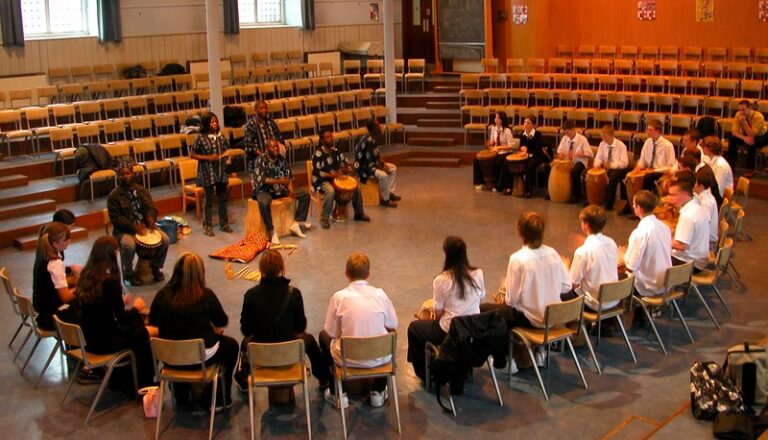
Children are encouraged not simply to watch and listen but to keep the timing, sing in call and response and dance with the musicians. During workshops they take this participation further, learning drum, percussion, vocal and dance parts themselves.
This allows children to experience both sides of performance — responding to professional performers as an audience and becoming performers themselves.
Music
Curriculum for Excellence encourages learners to sing and play music from different styles and cultures, develop musical ideas and experience the enjoyment of performing individually and with others.
Kakatsitsi’s programme gives children opportunities to:
experience live traditional Ghanaian music performed by professional musicians;
sing traditional songs and participate in call-and-response singing;
play drums and percussion instruments;
develop an awareness of pulse, rhythm, pitch, timbre, dynamics and musical structure;
listen carefully to individual musical parts and understand how they fit together;
maintain their own rhythmic part while other rhythms are being played;
experience how several different rhythmic patterns can interlock to create a collective rhythm;
experiment with rhythmic variations and simple improvisation; and
perform as part of an ensemble.
During the educational performance, children learn the timing pattern played by the bell and reproduce it on their knees. Different drum rhythms are then introduced around them, challenging the children to maintain their own timing by continuing to listen carefully to the bell.
This provides a practical demonstration of how listening, concentration and individual musical responsibility allow a group of musicians to perform together.
Dance
Dance provides another strong connection with the Expressive Arts Experiences and Outcomes.
Children experience traditional Ghanaian dance performed live and learn how movement relates directly to music. They are shown how the solo calls of the master drummer communicate with the dancers and guide particular movements.
Through performances and workshops, children have opportunities to:
experience dance from another cultural tradition;
learn and reproduce traditional Ghanaian dance movements;
respond physically to rhythm and musical cues;
link movements together into sequences;
develop coordination, control and confidence;
express themselves through movement; and
participate in collective dance.
The educational performance normally concludes with Kpanlogo, when the children — and their teachers — are invited to join Kakatsitsi’s dancers in a celebratory follow-the-leader dance.
Health and Wellbeing
Kakatsitsi’s programme supports aspects of Health and Wellbeing through movement, participation, confidence, cooperation and positive social interaction.
Drumming, singing and particularly dancing are active forms of learning. Children are encouraged to participate alongside others and experience the enjoyment of shared creative activity.
The programme can encourage:
physical activity and coordination;
confidence and self-expression;
cooperation and teamwork;
positive interaction with others;
participation and a sense of belonging; and
enjoyment through collective music and dance.
Religious and Moral Education
Kakatsitsi’s educational performance also provides opportunities relevant to Religious and Moral Education, particularly the development of understanding and respect for religious and cultural diversity.
At the beginning of the performance, the narrator explains the meaning of Kakatsitsi’s name — “Spiritual Strength” — before introducing a traditional libation ceremony.
Children learn about the importance of ancestors within traditional Ghanaian spirituality and how libation can be used to bring people together and express a sense of community and identity. They are taught simple responses and invited to participate before Kakatsitsi perform Agoo, their musical interpretation of the ceremony.
This gives children an opportunity to encounter beliefs and practices which may be unfamiliar to them, encouraging them to:
learn about beliefs and spiritual traditions different from their own;
recognise the importance of belief and ritual within other cultures;
ask questions about unfamiliar traditions;
develop respect for different beliefs and practices; and
consider some of the different ways in which people understand spirituality, community and identity.
Social Studies and Cultural Understanding
Kakatsitsi’s music is presented within its wider social, geographical and cultural context.
The narrator explains that Kakatsitsi come from Jamestown, a historic Ga fishing community in Accra, and introduces children to aspects of the lives and traditions of the people from whom the music originates.
Children learn about:
Ghana and its capital, Accra;
the Ga people of coastal Ghana;
Jamestown and its fishing traditions;
traditional fishing songs and the relationship between music and work;
community ceremonies and celebrations;
traditional instruments and how they are played;
spirituality and the role of ancestors; and
the communal role of music and dance.
This provides opportunities to explore relationships between people, place, work, belief, culture and community, while developing children’s knowledge and understanding of the wider world.
Literacy Across Learning — Listening and Talking
Kakatsitsi’s programme provides numerous opportunities to develop listening and talking.
Throughout the educational performance, children listen to explanations and demonstrations, follow verbal and musical instructions and respond to the performers.
Call-and-response singing requires children to listen to a phrase, remember it and respond appropriately. Rhythmic exercises similarly require careful listening before an accurate response can be made.
Where time permits, the performance concludes with questions from the children, giving them an opportunity to formulate questions and communicate directly with the musicians about Ghana, music, instruments, dance and the cultural traditions they have encountered.
Listening, Concentration and Working Together
Listening is central to Kakatsitsi’s approach and runs throughout both the educational performance and workshops.
Children are challenged to maintain a timing pattern while different rhythms are played around them. To succeed, they must concentrate on the bell as their reference point rather than allowing themselves to be distracted by competing rhythms.
In workshops, the same principle is extended into collective music-making. Children learn individual rhythmic, vocal or movement parts and then bring them together as an ensemble.
These activities encourage:
sustained attention and concentration;
careful and selective listening;
perseverance;
cooperation and teamwork;
responding appropriately to others;
maintaining an individual contribution within a group;
creativity within a shared structure; and
understanding how individual contributions combine to produce a collective result.
Learning About Other Cultures
One of the particular strengths of a Kakatsitsi school visit is that children encounter Ghanaian culture through direct contact with Ghanaian artists.
Rather than learning about another country and culture solely through books, recordings or screens, children can listen to Ghanaian musicians, watch them perform, participate alongside them and ask them questions.
This direct encounter encourages children to recognise cultural differences while also discovering shared human experiences — including family, work, music, dance, spirituality, celebration and community.
It provides an opportunity to approach another culture with curiosity, openness and respect, while developing a broader understanding of the wider world.
Further Information
Kakatsitsi’s educational programme can be adapted to different ages, abilities and school timetables. Schools are welcome to discuss particular Curriculum for Excellence priorities with Indigenous People when planning a visit.
Further information about Curriculum for Excellence, including the relevant Experiences and Outcomes, is available from Education Scotland.