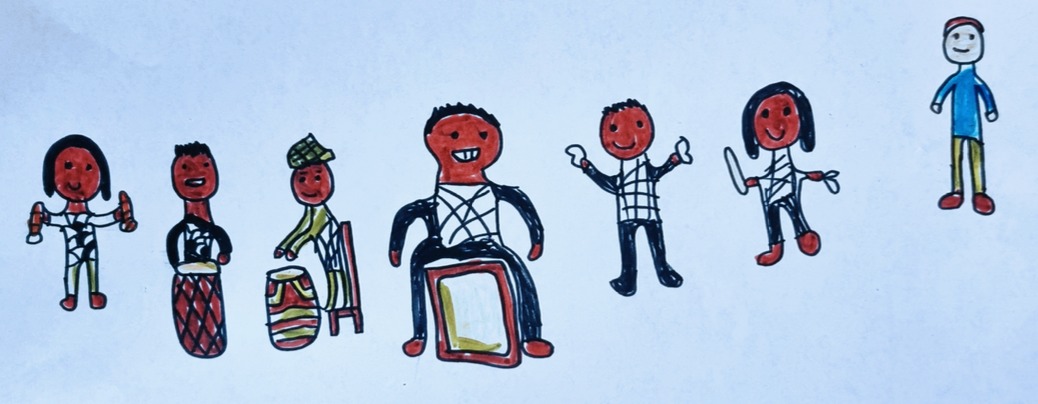
Kakatsitsi are a group of traditional drummers, dancers and singers from the Ga tribe of Southern Ghana, with their roots in the fishing community of Jamestown, the part of Accra where the British based their colonial headquarters.

Their music takes traditional rhythms and chants from their own Ga tradition and those of a variety of other West African cultures, rearranging them in a modern and accessible way. Since 1996, Kakatsitsi have toured the UK 15 times, working with a wide variety of festivals, arts centres and local authorities. The recent addition of a strong dance element, to complement the already outstanding drumming and singing components, has established Kakatsitsi as the leading African traditional group in the UK, with the leading Ga singers, drummers and dancers among their number.
Ideal for festivals, carnivals, street performances or village halls, Kakatsitsi can adapt to most environments. Seen live, they show culture as it is meant to be celebrated, breaking down the barriers between audience and performers by encouraging the active participation of the people in the celebration, whether on the drums, chanting or dancing. Recorded music is all very well, but with traditional music and dance the measure of the performance is in the involvement of the people in the spirit of the occasion. Kakatsitsi’s music combines traditional drumming grooves played on a wide variety of West African drums with traditional chants sung in six part harmony, the quality of which sets them above most dance-led traditional African groups.
The group have developed a particularly strong educational dimension, whereby they visit local schools or youth & community centres in the week running up to a performance to teach a few simple rhythms, chants and dances.


They then invite the children along to the final performance, where they join in with a final communal finalé, demonstrating what they have learned during the week. As well as fulfilling an important outreach and therefore marketing role for the performance, it also facilitates an all-important participatory component that helps generate the sense of community that is the inherent function of music and dance in traditional societies.

Kakatsitsi first visited the UK from June-December 1996, visiting a number of festivals with the EcoTrip DIY Cultural Caravan, a travelling edutainment roadshow with strong links to the environmental movement. Their appearance at Return to the Source, the pioneering trance club, introduced them to club culture and paved the way for a session in the studio with Medicine Drum, the trance-percussion fusion outfit. Later in the year, members of Kakatsitsi also played percussion on “Journey Between’ by Baka Beyond, a popular Afro-Celtic fusion group.
In 1997 and 1998 Kakatsitsi’s efforts to return to the UK to build on the success of 1996 were frustrated by the obstruction of immigration officials at the British High Commission in Accra who, concerned at the shoe-string nature of the 1996 tour, refused to grant the musicians permission to enter the country. While this cost the group’s management company dearly, the opportunity was taken to revamp the membership of the group and to record the group’s debut album – Etxo Mia Dogo (We will see you tomorrow). Recorded live in a garden in the Accra suburb of Osu, the recording features the occasional sound of the resident chickens as well as occasional sardonic references to the High Commission staff who were causing the group so many problems.
The album can be downloaded here.

The 2001 UK tour provided further recognition of the power of Kakatsitsi’s music and presence. After leading a small procession in Oxford in support of the Drop the Debt Campaign, Kakatsitsi attended the G8 summit in Genoa in July, performing in a church service and entertaining the protestors. One of the only representatives of the developing world, they went some way at least in fostering a carnival atmosphere of peaceful protest. During October, Black History Month, they visited 23 schools in the London Borough of Hammersmith and Fulham, culminating in an event at the Town Hall in which many of the schools presented a performance of the rhythms, dances and chants learned with the drummers during the week.
In 2002, Kakatsitsi once again toured the UK with Red Centre Dreaming, an Aboriginal performance company, on the Ancestral Voices tour. Funded by the Arts Council of England, the tour developed a unique fusion set between the tribal dance cultures of Ghana and Australia, performing at festivals and arts centres from Inverness in Scotland to Bodmin in Cornwall. With support from a grant from North-West arts, Kakatsitsi and Red Centre Dreaming were also able to develop a second ground-breaking fusion project combining the organic, human sounds of traditional drumming and chanting with the pulsating energy of Western dance music.
Building on their track record of success, particularly in the educational realm, Kakatsitsi’s 2003 UK tour saw them complete acclaimed projects with a wide variety of local authority partners. The highlight of the year, however, was a 7 week tour of Scotland, culminating in a week in Dundee developing a fusion set with some local traditional musicians, paving the way for future collaborations.
During 2004, Kakatsitsi have taken time off from touring to focus on developing new work and spent 3 months in Ghana, where they were developing a fusion project with western dance music producer Greg Hunter, supported by a development grant from the Arts Council of England.

In 2005, Kakatsitsi returned for another UK wide tour, the highlight of which was performing an opening ceremony at the Make Poverty History festival in Edinburgh before leading the march around the city.
An impromptu performance for Gordon Brown at a Christian Aid rally led to them collaborating with Bob Geldof to lead a reverential moment on the morning of the G8 summit.

2006 saw Kakatsitsi further develop their relationship with western club culture by performing at the ground-breaking Synergy Project and Kalahari club nights.
With the visit to the UK by the !Gubi Family, a group of San musicians and dancers from the Namibian Kalahari, Kakatsitsi participated in a unique concert that saw the joining forces with the San onstage to combine the two African traditions.

2009 also saw Kakatsitsi return to full time touring with a 6 week tour of Scotland. Beginning with a fusion set at the Edinburgh Mela, the tour saw Kakatsitsi visit remote communities such as Westray, Hoy, Eigg and Lochinver.
With the combination of three of the leading group members from Ghana with two of the London based members, the quality of the performances was recognised by the PAN network of the venues around the highlands and islands as one of the top 5 leading acts of that year.
Kakatsitsi returned to the UK for another tour in 2012, which saw them perform at a number of UK festivals such as Sunrise, Broadstairs Folk Week and Shambala before heading up to Scotland to perform at the African Drum Village, Belladrum Festival and at the Findhorn Eco-Spiritual community, before embarking on a 3 week performance and educational tour, taking in the Edinburgh Mela, Orkney International Science Festival, the Aros Centre on Skye as well as school visits in Inverness, Helmsdale, Thurso, Durness, Ullapool, Skye, Arisaig, Fort William and Kinlochleven.
In 2013, Kakatsitsi made further progress towards establishing themselves as one of the leading traditional drumming groups in Africa. The highlight of the tour was an appearance on the West Holts Stage at Glastonbury Festival with electronic dance music pioneers The Orb, in front of more than 8,000 people.
In addition to spending 3 weeks in the West Country teaching and performing, the group also spent 2.5 months in Scotland recording, performing and teaching, including memorable visits to Shetland, Skye and the Outer Hebrides.

2014 saw Kakatsitsi spent much of a 6 month tour in Scotland, where they participated in the cultural celebrations surrounding the Commonwealth Games, delivering educational workshops in schools across the country, delivering street drumming performances for the Queens Baton Relay and performing their new ‘in-house’ dance fusion set with former Ministry of Sound DJ Rebecca Vasmant. The set was debuted at the Knockengorroch ‘World Ceilidh’ as well as being performed at the Audio Soup Festival, the Edinburgh Mela and the Kelburn Festival.
2014 also saw the long awaitied (and perhaps long overdue) recording of Kakatsitsi’s second album ‘Agoo’, recorded in the studio at the Findhorn Eco-Village, in many ways the group’s spiritual home in the UK.
The album can be downloaded here.

The 2015 Kakatsitsi UK Tour saw them make along awaited appearance at the WOMAD festival, a visit to Dublin to perform at the Big Bang Festival of Rhythm, the African Drum Village in Perthshire, the Golowan Festival in Penzance, Tribal Earth in East Sussex, the Lancaster Music Festival, performances on the Scottish islands of Eigg, Muck and Skye, as well as schools tours of Aberdeenshire, East Lothian, Borders, the Highlands, Cornwall, Hampshire, Surrey, East Sussex and Kent.
2017 saw Kakatsitsi on tour across the UK, this time in fusion and collaboration with the !Gubi Family of San ‘Bushmen’ from the Kalahari desert in Namibia, with whom they performed an ‘inter-tribal fusion set’ at festivals such as WOMAD (where the two groups performed on the main stage), Shambala (main stage), Tropical Pressure (main stage), Tribe of Doris, Glasgow Mela, Eden Festival, Knockengorroch Festival and many more.

In 2019, Kakatsitsi made a return visit to the UK to conduct a 6 month long tour in collaboration with Mbilou, a Bwiti Nganga (ceremony leader, spiritual healer, musician and dancer) from Gabon. The set, rehearsed in Ghana between November 2018 and March 2019 was significantly mellower than the drummers’ traditional set, but brought a very welcome melodic element from the Mungongo Mouthbow and the Ngoma-Ngombi harp which sat easily on top of Kakatsitsi’s funky, accessile dance grooves.
Kakatsitsi returned to the UK in 2022 with a substantially revamped line-up, after 3 long standing members had to retire due to ill-health. A new generation of younger drummers, dancers and singers was recruited from the cream of Accra’s cultural community. This left only 2 members of the ‘original generation’, thankfully still including Samuel ‘Injoly’ Addo, musical leader, and Emmanuel Botchwey, Injoly’s right hand man. To make matters even more interesting, the British immigration authorities took an unprecedented 3 months to process most of the group’s visa applications, meaning that their arrival in the UK was delayed long past the proposed start of the tour. Fortunately the London based Kakatsitsi all-stars, made up of regular freelancers and former full time touring members was able to step in, but only for weekend work meaning that weeks of schools work had to be cancelled, leading to a significant loss of income.
Strangely, UK visas somehow failed altogether to process Injoly’s application at all, such that as the end of the tour approached his visa had still not come through. This remains a mystery. For the application of members who had not travelled at all before to be (eventually) processed and granted, while that of a musician who has travelled with Kakatsitsi more than 10 times, (as well as other international work) seems very strange.
While the loss of Kakartsitsi’s rhythmical talisman was a harsh blow, the qualitty of the new generation under Emmanuel’s effective leadership was able to cope admirably and the resulting tour was the smoothest and least stressful ever.